Mind-Bending Mechanics: Games That Challenge How You Play
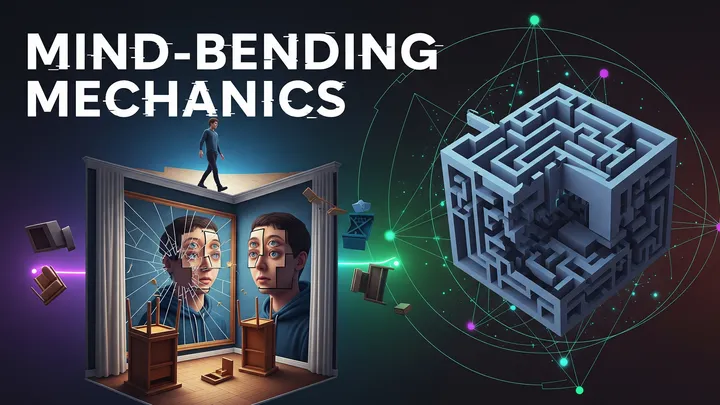
Some video games are designed to entertain, while others dare to do more. They don’t just provide you with quests, levels, or flashy graphics—they force you to question your assumptions about how games should be played. These are the mind-bending games: titles that push you outside your comfort zone, rewire your brain, and reward you with a sense of wonder once the pieces finally click.
Unlike traditional action or adventure games where reflexes dominate, these experiences thrive on curiosity, experimentation, and discovery. They are the kinds of games that make you pause, stare at the screen, and ask yourself, “Wait, can I really do that?” And when the answer is yes, the solution feels nothing short of brilliant.
Portal and Portal 2 – Redefining Space
When Valve introduced Portal, it wasn’t just another puzzle game—it was a revolution in how players understood space and physics. The portal gun is deceptively simple: create two portals and step through one to instantly emerge from the other. But the implications are massive. Suddenly, you’re solving puzzles by manipulating gravity, distance, and momentum itself.

By the time you reach the end of Portal 2, you’re no longer thinking about “going from point A to point B.” You’re calculating velocity, experimenting with angles, and bending the environment to your will. Few games can make players feel as clever and inventive as this one does.
The Witness – A Test of Pure Observation
Jonathan Blow’s The Witness begins innocently: a colorful island filled with grid-based line puzzles. Yet, it doesn’t take long before you realize the true genius of its design. The island itself is a puzzle, and the solutions are hidden in plain sight.
Shadows might reveal the correct path, the sound of the wind could provide a hint, and even the angle of your perspective becomes essential. The game teaches you to see differently—to slow down and notice the details of your environment. By the end, you realize that you weren’t just solving puzzles; you were training your brain to be more observant.
Superliminal – Playing with Perception
What if perspective wasn’t just a visual trick, but the core mechanic of a game? That’s the genius of Superliminal. Pick up an object, adjust how you’re looking at it, and suddenly it changes size in reality. A tiny chess piece can become a massive obstacle, or a toy block can turn into a staircase.

Every puzzle feels like it’s breaking some unwritten law of reality. It’s disorienting, sometimes maddening, but always rewarding. The game constantly asks you to question what’s possible, reminding you that in its world, perception is everything.
Outer Wilds – A Universe to Unravel
At first glance, Outer Wilds looks like a charming space exploration game. But soon, you discover its true identity: a time-looping mystery that unfolds across an entire solar system. Every 22 minutes, the loop resets, and you start again—armed not with weapons or tools, but with knowledge.
The brilliance of Outer Wilds lies in how it redefines progress. You don’t gain power or upgrades; instead, you gain understanding. One loop might teach you how a planet collapses into a black hole. Another reveals ancient alien writings that change how you view the universe. The game rewards not action, but curiosity and persistence.
Baba Is You – Changing the Rules of Reality
Few puzzle games are as bold as Baba Is You. Instead of solving puzzles within the game’s rules, you rewrite the rules themselves. Words on the screen—like “Wall Is Stop” or “Baba Is You”—aren’t just instructions, they’re moveable blocks. Push them around, and suddenly walls no longer block your path, or you cease being “Baba” and transform into something else entirely.
Every level feels like you’re breaking the game, but in truth, you’re learning to think outside the box in ways no other title demands. It’s the perfect example of how language, logic, and creativity can combine into something truly mind-bending.
Antichamber – The Impossible Maze
If Portal makes you rethink physics, Antichamber makes you rethink logic itself. At first glance, it looks like a simple first-person puzzle game with minimalist visuals. But soon, you realize the world doesn’t obey traditional rules. Corridors loop back on themselves, staircases vanish when you look away, and progress often comes from unlearning everything you assume about space.
The result is a game that feels like stepping into an M.C. Escher drawing come to life. It’s a constant reminder that in video games, rules are meant to be rewritten.
Why These Games Matter
Mind-bending games aren’t just about clever mechanics. They represent a deeper philosophy in game design: the idea that play should challenge our thinking as much as our reflexes. By twisting perception, bending rules, or demanding radical creativity, they push players into uncharted territory.
In an industry often dominated by sequels and predictable formulas, these games stand out as bold experiments that trust players to think, adapt, and discover.
Conclusion
Mind-bending games leave a lasting mark because they are more than entertainment—they are intellectual playgrounds. They teach us to embrace frustration, to see the world differently, and to celebrate the joy of discovery. Whether it’s bending space with portals, changing the rules of reality, or piecing together the secrets of a solar system, these games prove one thing: the best challenges in gaming aren’t about reflexes but about imagination.